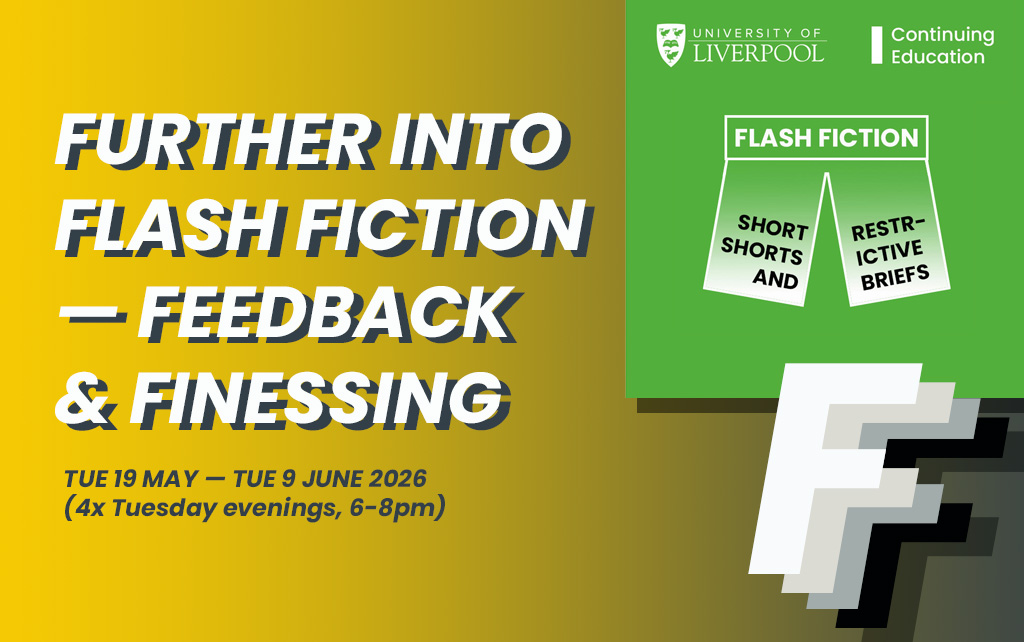
Further into Flash Fiction — Feedback and Finessing
Four evening workshops (6-8pm, Tue 19 May — Tue 9 June 2026) on campus at the University of Liverpool (venue TBC).
‘Further into Flash Fiction’ is a four-week follow-on course from ‘Flash Fiction: Short Shorts & Restrictive Briefs’ (Term 2) for any writers who would like to receive group feedback on their works in progress. It is not essential to complete the eight-week Term 2 course beforehand and this short course is open to all writers who have some existing short story drafts or pieces of flash fiction (under 1,000 words each) that they would like to develop, revise and receive feedback on.
It may also appeal to writers who wish to write a cycle of linked short stories or work towards creating a Novella-in-Flash.
Please see ‘Overview’ and ‘Syllabus’ drop-downs below for further details.
Course details
This four-week short course runs from 6-8pm on Tuesday evenings from 19 May to 9 June 2026.
‘Further into Flash Fiction’ is a four-week follow-on course from ‘Flash Fiction: Short Shorts & Restrictive Briefs’ (Term 2) for any writers who would like to receive group feedback sessions on their works in progress. It is not essential to complete the eight-week Term 2 course beforehand and this short course is open to all writers who have some existing short story drafts or pieces of flash fiction (under 1,000 words each) that they would like to develop, revise and receive feedback on.
We will also look at ways of linking several flash fiction pieces (e.g. with recurring characters, themes or locations) for participants wishing to build a collection of linked short stories or a novella-in-flash. This short course aims to allow students time to edit existing short fiction as well as to explore some of the themes that could be pulled out and expanded upon in new pieces of writing. While there will be some prompts and writing exercises, there will be a greater emphasis on giving and receiving group feedback in a relaxed environment.
Phil will give guidance, steering the group, rather than teaching the fundamentals of short fiction writing. You don’t need lots of writing experience, but ideally you will have a few drafts or works-in-progress that you wish to share and improve. Participants will develop their ability to read as writers and to give constructive feedback. They will also feel equipped to edit and redraft their fiction and able to spark life into existing stories. By the end of the course, they will have an idea of how a novella-in-flash might be put together, and whether they want to link their own pieces of short fiction or simply develop them as individual flashes.
Each week will have a loosely themed framework, but these are not taught sessions. The bulk of all four workshops will be spent sharing work and giving and receiving feedback.
Week 1 (Tue 19 May) – Introductions and giving & receiving feedback. Introducing the group to each other and looking at how to get the best out of being critical friends to each other. Time to write, edit and share work.
Week 2 (Tue 26 May) – Novella-in-Flash and linked stories. Exploring ways of linking pieces of fiction (recurring characters, themes and locations etc, or a shared genre). Time to write, edit and share work.
Week 3 (Tue 2 June) – Where to submit short stories and flash fiction. Whether you’re building a collection or just want to send individual pieces out into the world. Time to write, edit and share work.
Week 4 (Tue 9 June) – Forming a writing group and building good habits. Set yourself deadlines. Set up monthly meet-ups (online or in person) so you can share work and give each other feedback. Time to write, edit and share work.
Phil Olsen is a short story writer with a Creative Writing MA from the University of Manchester’s Centre for New Writing. In 2023 he ran a Canning Dock flash fiction competition with Writing on the Wall and National Museums Liverpool, delivering free workshops across Merseyside libraries. He has also run workshops for Write Generation in Toxteth, the L20 Hub at Netherton Library, and the Community Lottery-Funded Floral Civilians project in New Brighton.
Winner of the University of Liverpool’s Short Story Competition in 2022, Phil has previously won the Northern Short Story Festival, WoWFest, and Book Week Scotland flash fiction competitions. His short fiction has been published by Ad Hoc Fiction, Cōnfingō, The Liminal Residency, Storgy and Strix.
He was commissioned as a writer by the Science Museum and by Manchester’s Victoria Baths. Phil’s editorial roles have included Fiction Editor at Sabotage Reviews and Contributing Editor at Vestal Review.
Course fees
Standard fee: £60
Concession fee: £30
Enrol via the University of Liverpool Continuing Education website
Visit the University of Liverpool’s Continuing Education web pages for upcoming Creative Writing courses.